
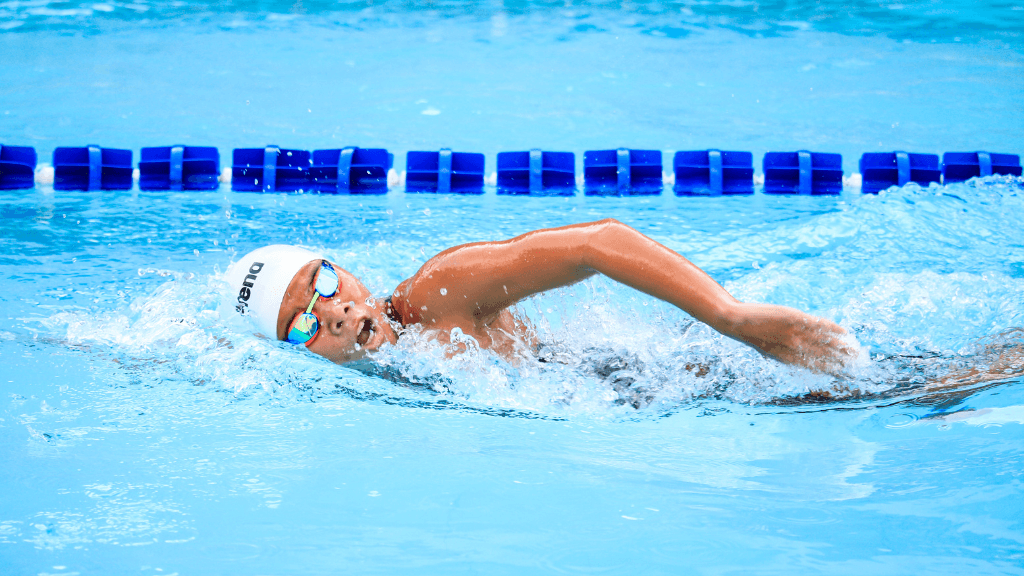
It is commonly assumed that the quickness with which you move your arms and legs determines your speed in the pool. However, fundamentals, such as breathing correctly and proper balance, will help you perform better in the water.
Aside from supplying your muscles with the required oxygen to function, breathing accurately will help with speed, pace, and correct form, making you a well-rounded swimmer across various stroke disciplines.
This article will outline how to breathe when swimming, explaining different approaches in execution.
How to Breathe in Freestyle Swimming
Timing your breath entirely with your stroke is an essential technique to learn when swimming freestyle, helping to balance your body.
Practice breathing every three strokes and switching sides for proper form: breathe at the third stroke, gently rotating your head sideways to breathe at the side, and recovering the arm over the water during the stroke cycle.
Rehearse breathing in odd numbers, starting with three and moving to five on each side for proper form, ensuring each stroke arm is evenly counterbalanced.
Do not overextend the roll onto your back when freestyle breathing. Focus on turning your head slightly, quickly breathing to resume your normal neutral head position.
For athletes at the competitive or more advanced level, limit the amount you breathe as you approach the end of the pool, ready for a turn. Hold your breath from the flags to the wall, turning, kicking underwater into three strokes, and then taking a breath. At this level, try not to breathe as you approach and depart the wall, maximizing your speed in and out of the turn. 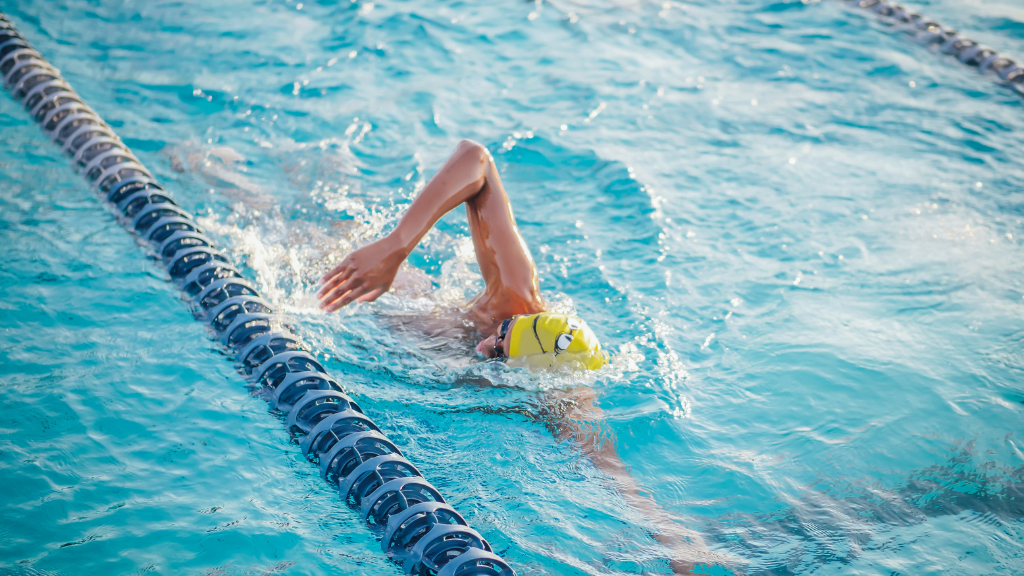
How to Breathe Underwater
While knowing how and when to breathe on the surface is imperative for form, performance, and technique, understanding how to breathe underwater is just as important. It is common practice that swimmers hold their breath underwater after taking a breath at the surface. However, this is counterintuitive to swimming performance.
Once you have breathed at the surface and your face has entered the water, exhale slowly and deliberately, whether through your nose or mouth.
Be gradual with your exhalation, as breathing too quickly may result in inhaling water. After you have slowly exhaled, begin your next breath—this should operate like clockwork, with your exhale synchronizing with every stroke as you inhale.
Breathing Techniques for Swimming
Stroke disciplines and techniques differ in terms of when you breathe. We’ve previously mentioned freestyle – alternating breaths every three strokes.
Backstroke (because you are positioned entirely on your back) involves constant breathwork. Time your breath with your strokes, making steady, rhythmic breathing – inhaling when one arm is recovering and exhaling when the other begins a stroke. For advanced swimmers, turning at the wall when performing backstroke with a tumble turn will require a flip onto your front, taking a single short breath at the wall before you turn.
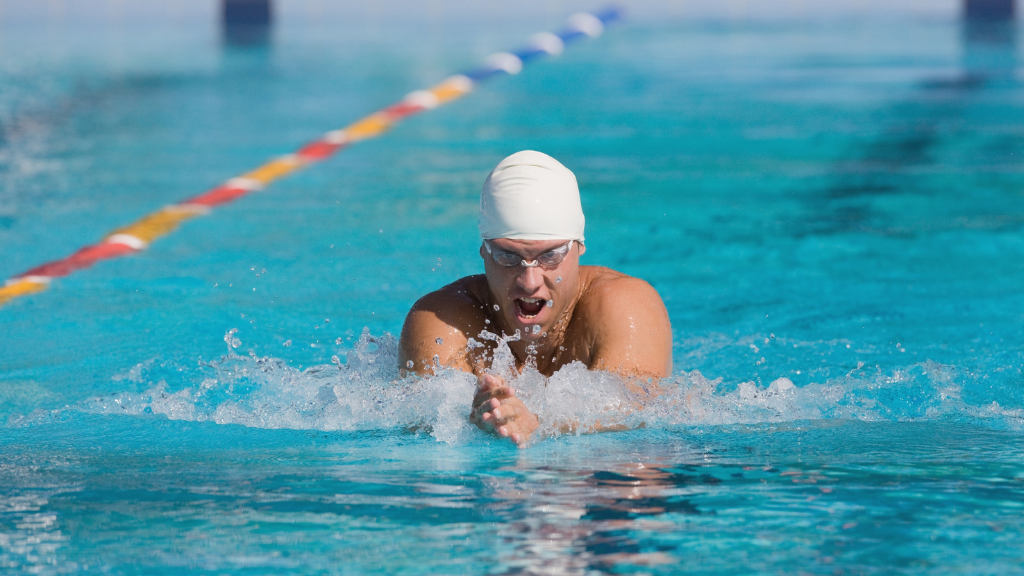
Regarding breaststroke, taking a breath after lifting your body out of the water after every stroke is proper form. Lift your body out of the water when executing breaststroke, inhaling as you elevate your body and exhaling as you enter the water during the glide phase. Practice this technique by starting with slow strokes to master the correct motion and timing of the breath.
Butterfly breath work is similar to breaststroke but differs in the level of proficiency needed for execution. While some novice swimmers breathe every stroke when performing butterfly, taking a breath every two to three strokes is common among advanced swimmers to maximize speed and reduce drag.
Like breaststroke, as you lift your body out of the water in one full stroke, inhale and exhale as you enter the water, completing your stroke cycle and preparing for the next. Unlike breaststroke, your chin must skim the water as you breathe, moving to a neutral position with your head as you enter the water.
How to Breathe When Swimming Laps
We’ve covered how to breathe across different strokes. But what about when lap swimming, especially over long distances?
Much of what we’ve mentioned, including stroke form and breathing technique, stays the same. However, what may differ is how often and how deeply you breathe.
When swimming laps, you want a consistent, relaxed, deep breath to sustain your pace over long distances. Pick a breathing pattern that works for you. Adopt a suitable routine, such as breathing every three or five strokes on freestyle or every two on butterfly.
Comfort is key here, with the frequency of breathing matching your pace, skill set, and requirements. Play around with the right approach, testing which patterns work and which do not.